
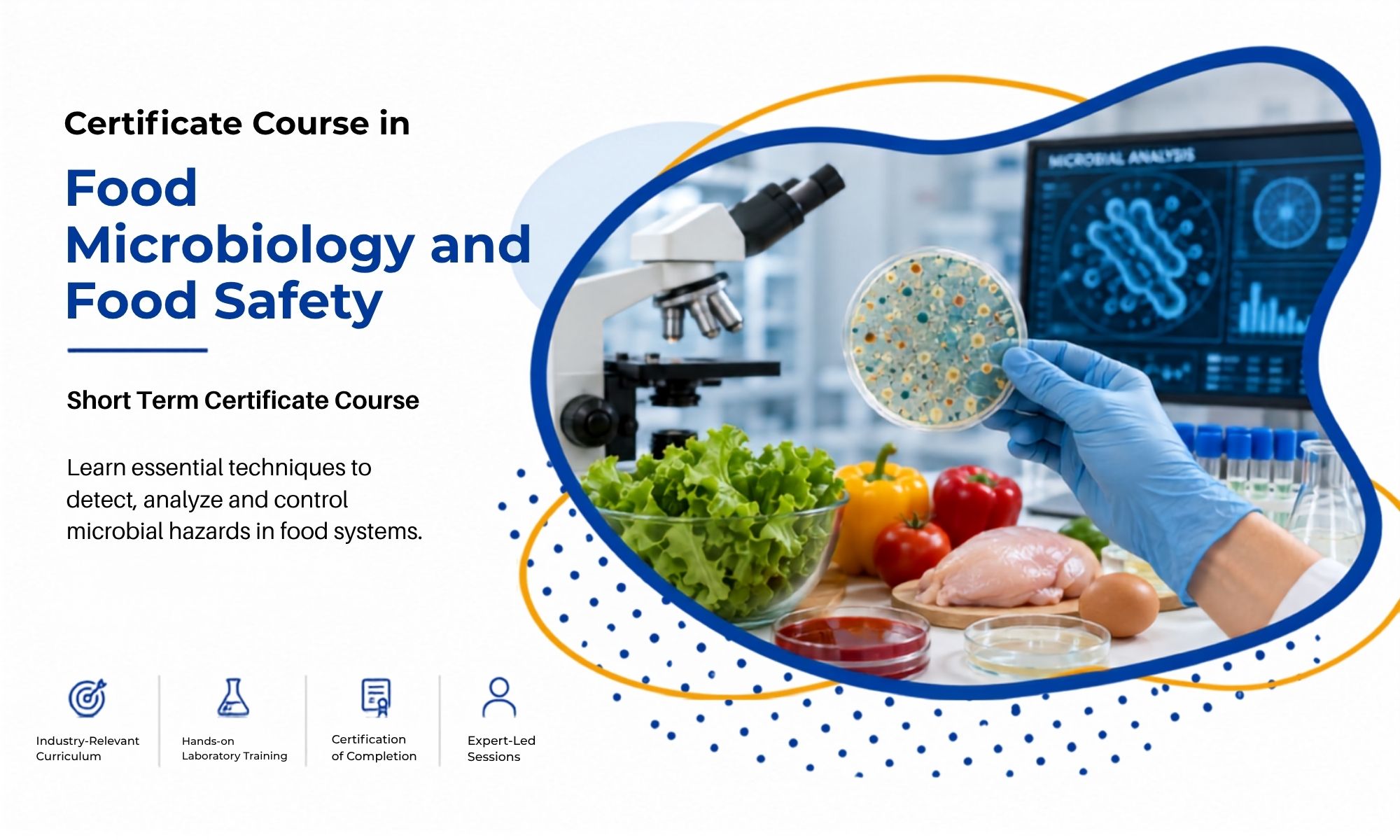
Certificate Course in Food Microbiology and Food Safety
Course Overview
Food Microbiology is the study of microorganisms associated with food, including beneficial microbes involved in fermentation, spoilage microorganisms, and foodborne pathogens. Food Safety encompasses the scientific principles and practices used to prevent contamination and ensure that food is safe for consumption from production to consumption. Increasing globalisation of food trade, emergence of antimicrobial-resistant pathogens, and consumer demand for minimally processed foods have made food microbiology an essential discipline.
This certificate course provides comprehensive knowledge of food microorganisms, food spoilage, foodborne diseases, microbial quality assessment, preservation techniques, food safety management systems, HACCP, GMP, sanitation, food legislation, and emerging technologies in food safety. Students will also gain practical laboratory skills for microbiological analysis of food samples and interpretation of food quality standards.
Course Details
- Mode: Online + Offline (Practical/Laboratory Work)
- Level: Intermediate / Advanced
- Duration: 30 Hours Theory + 10 Hours Practical/Laboratory Work
- Language: English
- Format: Online lectures, learning materials, quizzes, assignments, case studies & hands-on laboratory work
- Eligibility: Undergraduate and postgraduate students in relevant life-science disciplines
What Will You Learn?
By the end of the course, students will be able to:
1. Explain the role of microorganisms in food quality and safety.
2. Identify microorganisms responsible for food spoilage and foodborne illnesses.
3. Perform microbiological analysis of food products.
4. Apply food preservation techniques to control microbial growth.
5. Understand HACCP, GMP, GHP, and food safety management systems.
6. Evaluate food quality according to microbiological standards.

Course Outcomes
On successful completion of the course, students will be able to:CO1: Understand Food Microbiology & Microbial Growth
Explain the fundamentals of food microbiology and identify the key factors that influence microbial growth in food systems.
CO2: Develop Food Microbiological Testing Skills
Perform microbiological testing methods to assess food quality and safety.
CO3: Apply Food Safety Management Practices
Apply food safety management principles, including HACCP and GMP, in food production and processing environments.
Certificate
Students who complete the course requirements and assessments will receive a Savitr Bioscience Certificate of Completion in the Certificate Course in Food Microbiology and Food Safety.
The certificate recognises successful completion of the course and participation in its prescribed learning and practical components.
Need our expertise?
Sent us a message